Tap a photo to enlarge it
SVR.56
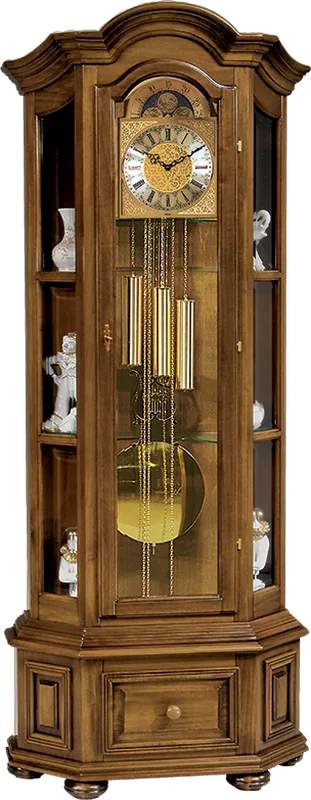
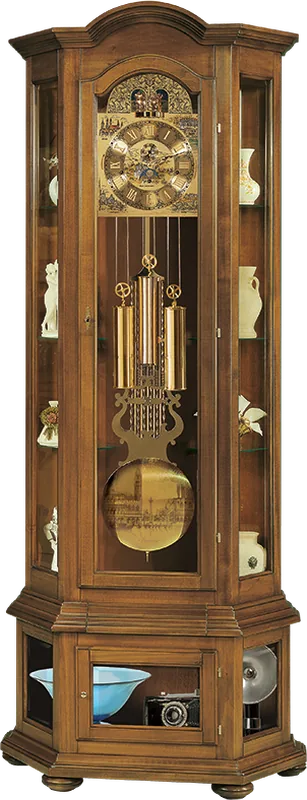
Curio cabinet clock
A showcase for your dearest things, with a hand-painted dial and four dancers that come out every quarter hour. The base and the upper cabinet screw together, and the upper cabinet can also stand on its own, on the floor.
A clock that is yours alone. Wood, finish, colour and melody: we start from this model and finish it together, the way you want it.
- Dimensions
- Height 224 cm · width 86 cm · depth 35 cm · weight 90 kg
- Wood
- Solid American tulipwood; back in plywood veneered in Tanganyika
- Finish
- Medium walnut, semi-gloss, water-based, each part finished separately
- Movement
- German Kieninger mechanical movement in mirror-polished brass; weekly cable winding with the crank in the 3 dial holes; switchable night silencer from 10 pm to 7:15 am; hands can also be turned anticlockwise
- Chime
- Three chimes on 8 notes, Westminster, Whittington and St Michael, every quarter hour, with the hour strike; switchable automatic chime change every hour
- Dial
- Hand-painted by Paul Merkte with Europe's monuments; applied brass numerals; four carved and painted wooden dancers that move every quarter hour; no seconds hand, no moon phase
- Pendulum
- Brass lyre pendulum and decorated weights by Jaeckle
- Other
- 6 hand-bevelled 5 mm glass panes, arch included; 2 large glass shelves from side to side; 220 V / 110 V interior light, not to be left on all the time; lock on the upper door; small drawer; glazed base and upper cabinet screw together; 4 bun feet that unscrew
How it is made
It is an Italian-style cabinet, graceful and bright, that adapts to many places. It can stand on its glazed base or straight on the floor, against a wall or in a corner, thanks to its two 45° sides. It is all solid American tulipwood, with a back in plywood veneered in Tanganyika. The small drawer holds the instructions, the door key and the winding key.
The six 5 mm glass panes, the large arch included, are bevelled by hand by Giovanni Casella. Stefano finishes each part on its own in a semi-gloss, water-based medium walnut, and only then do we put it together, while we test the movement for at least 15 days: this keeps the finish clean and smooth. Inside are two large shelves from side to side and an interior light. The four bun feet unscrew, and the upper cabinet screws onto the base once the clock is in place.
The dial is painted by hand by Paul Merkte, an elderly German impressionist painter, with Europe's great monuments and applied brass numerals. At the top, four wooden dancers, carved and painted, spin and move in and out every quarter hour while the clock chimes, as on Marienplatz in Munich. The large, mirror-polished Kieninger movement has three chimes on 8 notes and can switch between them by itself every hour. It is cable-wound once a week, with the crank in the three holes of the dial: no chains in front of the pendulum disc.