Tap a photo to enlarge it
SZR.04
Grandfather clock
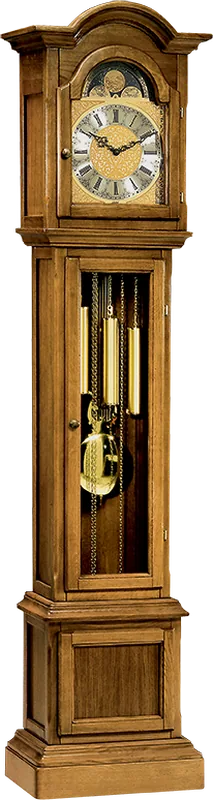
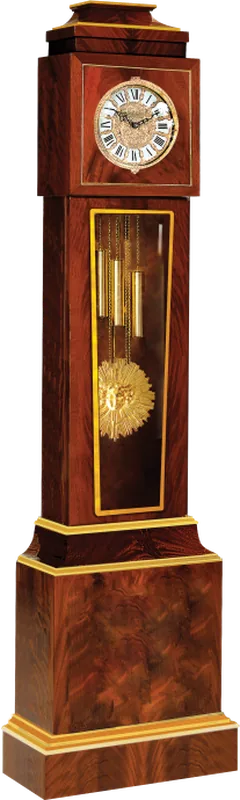
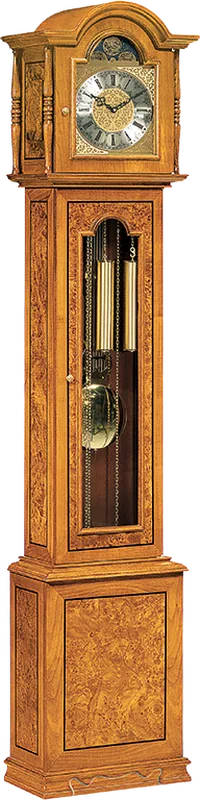
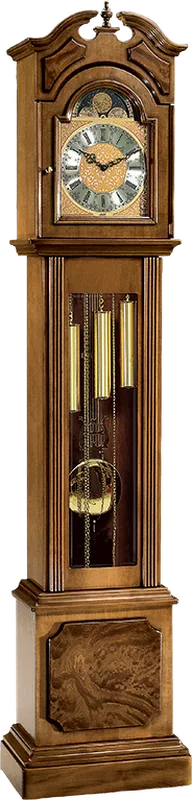
An English-style longcase clock, built in three parts. We widened the dial with its large moon phase and lightened the mouldings at the top, so the clock stays slim.
A clock that is yours alone. Wood, finish, colour and melody: we start from this model and finish it together, the way you want it.
- Dimensions
- Height 211 cm · width 46 cm · depth 28 cm · weight 60 kg
- Wood
- Solid tulipwood; plain parts in MDF veneered in Tanganyika; pre-composed burl details by Alpi; Italian walnut finial
- Finish
- Semi-gloss walnut, water-based with a nitro top coat, inside and out
- Movement
- German Kieninger mechanical movement in brass; weekly chain winding (up to 10 days); switchable night silencer from 10 pm to 7:15 am
- Chime
- Westminster every quarter hour
- Dial
- Widened, with a large moon phase, by the German firm Jaeckle
- Pendulum
- Brass lyre pendulum and brass weights by Jaeckle
- Other
- Three parts; blown glass with a large arch over the moon phase; two half columns applied to the door; the hood slides forward like a drawer
How it is made
The design is English, and it was the English who first placed these clocks in post stations and inns. Knowing when the next full moon was due meant you could travel at night too. This is why the glass of the upper door has a large arch that shows the moon phase clearly: the moon moves on one click a day through new, waxing, full and waning.
The case is solid tulipwood; the plain parts are MDF veneered in Tanganyika, with details in pre-composed burl by the Alpi company. The finial on top is real Italian walnut, and two half columns are applied to the door. The glass is blown. Our Stefano finishes the whole case, inside as well as out, with water-based coats and a semi-gloss walnut nitro top coat; the back is finished separately.
The hood slides forward like a drawer: this is how we fit the movement, and it keeps it easy to reach. The Kieninger movement plays the Westminster chime every quarter hour and can stay silent at night. It is wound once a week by pulling the chains, and each weight drops about 12 cm a day.