Tap a photo to enlarge it
SZR.14
Grandfather clock
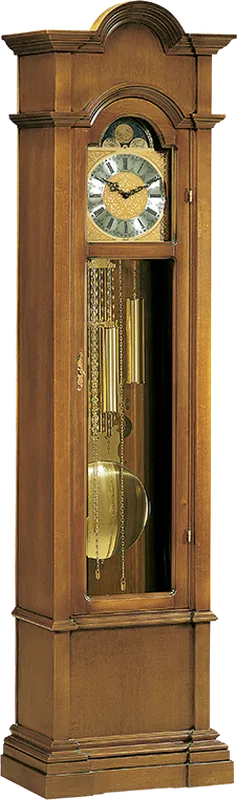
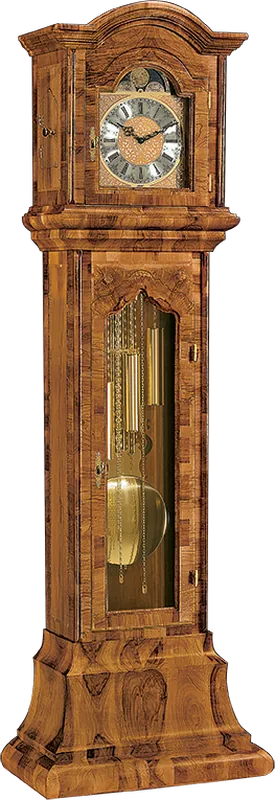
A Venetian “Ca' Rezzonico” clock, built and finished as in the homes of the Venetian upper class under the Republic. The mouldings are made of many small walnut pieces laid cross-grain, so you see the grain and feel it under your hands.
A clock that is yours alone. Wood, finish, colour and melody: we start from this model and finish it together, the way you want it.
- Dimensions
- Height 208 cm · width 68 cm · depth 38 cm · weight 70 kg
- Wood
- Naples and Caserta walnut in 5 mm pieces, laid with fish glue and small nails on a maple board frame; cross-grain mouldings; fir board back
- Finish
- Shellac, 10 to 14 coats by hand; light nitro finish for export; green velvet interior
- Movement
- German Kieninger mechanical movement in brass; weekly chain winding (up to 10 days); switchable night silencer from 10 pm to 7:15 am
- Chime
- Three melodies to choose from, on 8 notes: Westminster, Whittington, St Michael; hour strike
- Dial
- Moon phase dial by the German firm Jaeckle
- Pendulum
- Brass lyre pendulum and brass weights by Jaeckle
- Other
- 5 mm hand-bevelled glass; flat embroidered green braid; two small side doors on the hood with hinges from caskets and jewellery boxes; new locks and keys; low door arch, as in the originals, which had no moon phase; the hood lifts off upwards; bottle of straw-coloured oil included
How it is made
This is the style of the grand houses of 18th-century Venice, in the days of the Republic. On a frame of maple boards we lay small pieces of Naples and Caserta walnut, 5 mm thick, hot-glued with fish glue and held by thousands of small nails while the glue dries. All the mouldings are cross-grain: the figure breaks into many small pieces and the colour of the walnut takes over. The wood is old, perhaps a hundred years, and we chose it for this clock more than forty years ago.
Rebuilding 300-year-old clocks with wood that is already 100 or 200 years old is the craft our founder, Antonio Altobel, began learning in a workshop at the age of 8, in Venera di Sanguinetto. There is no varnish over the grain, only shellac: 10 to 14 coats, laid by hand by him or by Mrs Ambrosi. So you can see and touch the grain, and even smell the wood. Mrs Daniela, our co-founder, lines the inside with green velvet, and a flat, embroidered green braid runs round the bevelled glass.
With changes in temperature and humidity the small pieces move, and a fine edge can show between them: that is how the case is built, not a defect. We include a bottle of straw-coloured oil to keep feeding the wood, and for export Giorgio adds a light nitro finish. The Kieninger movement offers three chimes and a moon phase. The hood lifts off upwards, and the two small doors on its sides, hung on hinges taken from caskets and jewellery boxes, give access to the movement.