Tap the photo to enlarge it
SZR.36
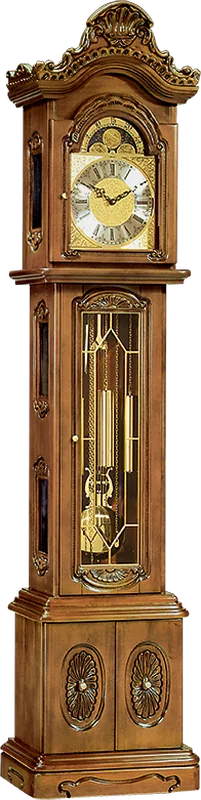
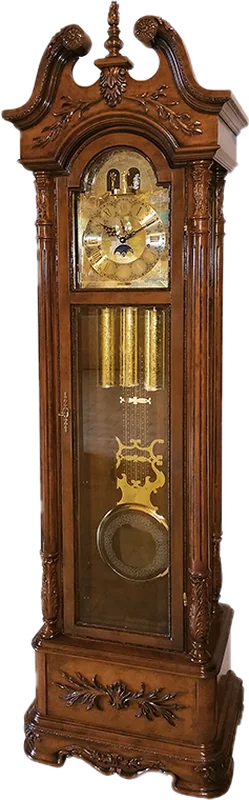
Grandfather clock
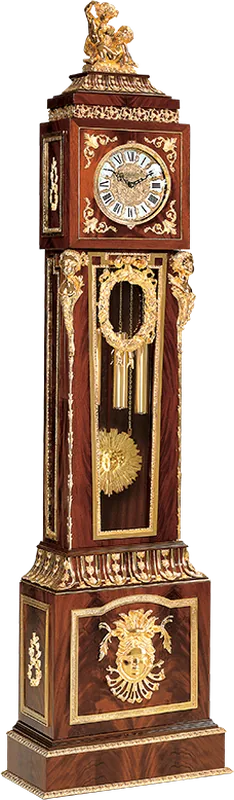
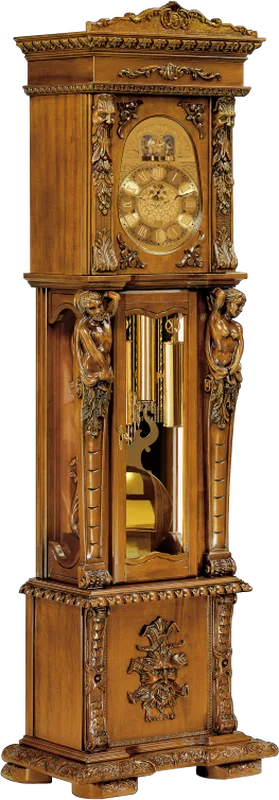
A large clock in late Italian Renaissance style for grand homes, with the traditional taste of central Italy. Its Kieninger movement has three chimes that change by themselves and four dancers on the dial.
A clock that is yours alone. Wood, finish, colour and melody: we start from this model and finish it together, the way you want it.
- Dimensions
- Height 216 cm · width 61 cm · depth 38 cm · weight 100 kg
- Wood
- Solid American tulipwood; plain parts in MDF veneered in Tanganyika; carved parts in French lime wood; fretwork door decorations in Italian walnut; back in heavy veneered and stabilised MDF
- Finish
- Walnut, water-based with a nitro top coat, piece by piece before assembly
- Movement
- Large German Kieninger mechanical movement in mirror-polished brass; cable-driven, wound weekly with a crank in the 3 holes of the dial; switchable night silencer from 10 pm to 7:15 am
- Chime
- Three chimes on 8 notes every quarter hour: Westminster, Whittington, St Michael; hour strike; switchable automatic change of chime every hour; long brass-plated bells
- Dial
- Germany's major monuments and large applied numerals; four painted dancers that turn and come out every quarter hour
- Pendulum
- Brass lyre pendulum and decorated weights by Jaeckle
- Other
- Two caryatids and a mask carved by hand; four half columns; door with lock; hand-bevelled glass, in the oval of the upper door and on the sides too; the upper part unscrews from the back and slides forward like a drawer; four carved feet that unscrew
How it is made
It tells the three stages of life. At the bottom, the mask, with hardship and harshness; in the middle, humankind, the two caryatids at the sides, toiling towards peace and light; at the top, the door to the movement, with its decorated dial. The carved parts are French lime wood: Carlo roughs them out and Franco carves them by hand, from the two statues at the sides and the mask below to the details along the mouldings.
The case is solid American tulipwood, with the plain parts in MDF veneered in Tanganyika. The Renaissance design has four raised feet, fluting on the plain parts and four half columns. Mrs Angelica cuts the fretwork decorations on the door in Italian walnut, and there are hand carvings inside the back too: this model once had no door, and we added one, with a lock, for safety. Giovanni bevels the glass by hand all the way round, in the oval of the upper door and on the sides too. Stefano finishes each piece in walnut, water-based with a nitro top coat, and only then do we assemble the clock: assembly takes a good 15 days, to test every accessory.
The Kieninger movement is large, in mirror-polished brass. Every quarter hour it plays the Westminster, Whittington or St Michael chime on 8 notes, as you choose, strikes the hours and can change tune by itself every hour. On the dial, with Germany's major monuments and large applied numerals, four painted dancers turn round and move in and out every quarter hour, as on the Marienplatz in Munich. It is cable-driven, so there are no chains in front of the pendulum: it is wound every week with a crank in the 3 holes of the dial. The four carved feet unscrew if you want the clock to stand directly on the floor.