Tap a photo to enlarge it
SLR.48
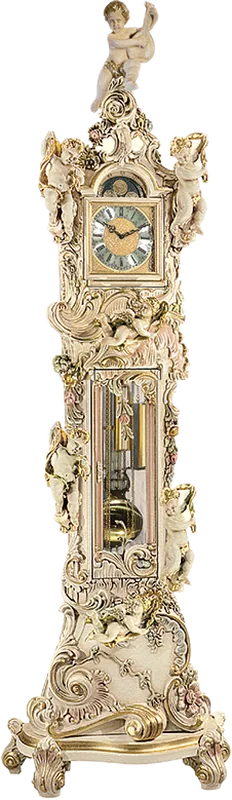
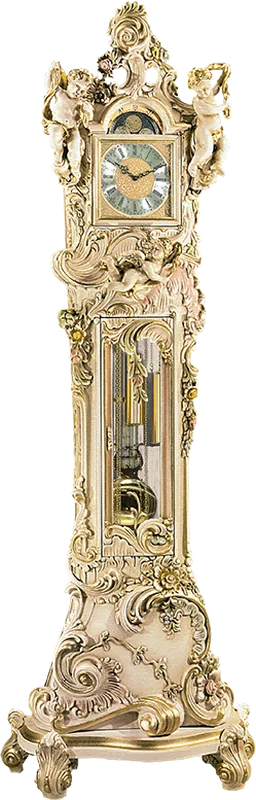
Lacquered grandfather clock
Viennese Rococo in solid French lime wood, carved by hand and lacquered in white crackle with real gold leaf. Three angels, four small feet and a moon phase dial.
A clock that is yours alone. Wood, finish, colour and melody: we start from this model and finish it together, the way you want it.
- Dimensions
- Height 217 cm · width 79 cm · depth 35 cm
- Wood
- Solid French lime wood, up to 12-14 cm thick; frame in bent Tanganyika and maple; MDF back
- Finish
- White crackle Venetian lacquer with polychrome touches; real gold leaf; matt acrylic clear coat
- Movement
- German Kieninger mechanical movement in brass; weekly chain winding (up to 10 days); switchable night silencer from 10 pm to 7:15 am
- Chime
- Westminster every quarter hour
- Dial
- Moon phase dial; classic northern European or hand-painted by Paul Merkte; hands of our own design, signed
- Pendulum
- Brass lyre pendulum and weights by Jaeckle
- Other
- Three carved angels and four small feet; 5 mm dial glass bevelled by Giovanni Casella; below, blown glass with applied leaves and screwed strips
How it is made
It comes from the family of the workshop's first Viennese Rococo clock, born in the early years from a photo of a clock in Vienna: low, in walnut and without angels. Over the years we made it taller and larger and lacquered it, adding the moon phases, four small feet and three angels. The case is solid French lime wood, up to 14 cm thick, and the wood seasons for up to ten years: one year per centimetre.
We rough the wood out on a manual pantograph, then Franco Franzoso of Rovigo carves it by hand: the four small feet, the base, the body and the large angel in the centre. Each part is worked separately and fitted after finishing. The lacquer is Venetian: white crackle with small touches of colour and an environmentally friendly matt acrylic clear coat. The real gold leaf is laid by Lara Finotti, a painter from Bovolone.
The Kieninger movement plays the Westminster chime every quarter hour. The moon on the dial moves on by one small step a day, showing its place in the sky. It is wound once a week by pulling the chains: each weight drops about 12 cm a day. The dial can be the classic northern European one or hand-painted by the German painter Paul Merkte, with Europe's great monuments and a moon with a face.