Tap a photo to enlarge it
SMR.94
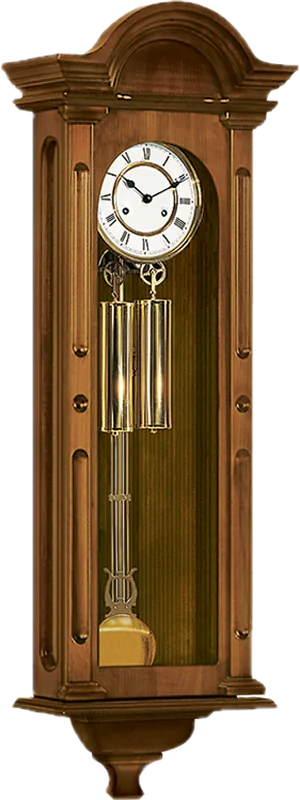
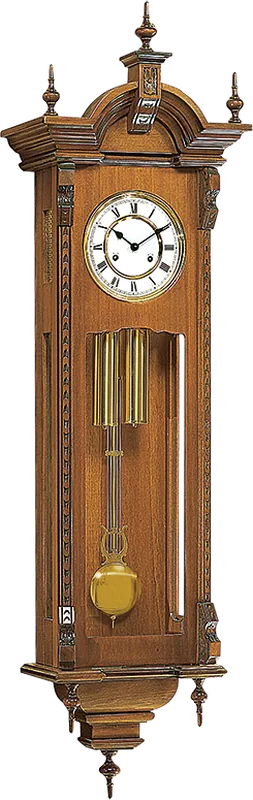
Wooden wall clock
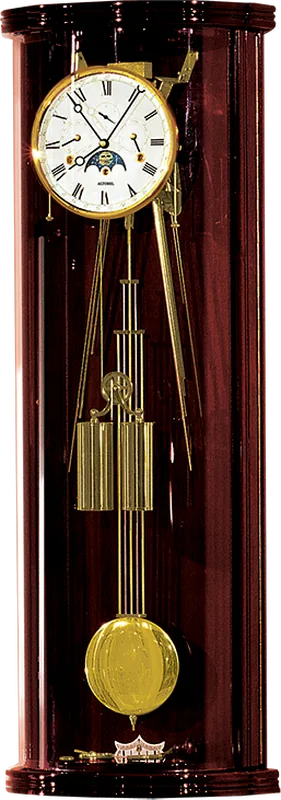
Here the movement takes centre stage. Behind a deeply curved glass, the pendulum swings in front of a mirror-polished Kieninger movement, with a dial that also shows the moon phase, date, day and month.
A clock that is yours alone. Wood, finish, colour and melody: we start from this model and finish it together, the way you want it.
- Dimensions
- Height 108 cm · width 39 cm · depth 23 cm · weight 50 kg
- Wood
- Double panel in MDF veneered in Tanganyika; edges in solid American tulipwood
- Finish
- Glossy mahogany polyester, applied part by part
- Movement
- German Kieninger mechanical movement in brass, mirror-polished; weekly double winding: key for the 2 chime springs, crank for the cable with 2 twin weights; self-centring, self-regulating and self-lubricating; the hands can also be turned anticlockwise; switchable night silencer from 10 pm to 7:15 am
- Chime
- Westminster and the hours struck on 8 extra-long brass-plated rods; lever to the right of the dial to silence it completely
- Dial
- White and flat, by the German firm Jaeckle, with moon phase, concentric date, day of the week, month and exact seconds hand; Breguet hands
- Pendulum
- Extra-long grid-style pendulum by Jaeckle; genuine porcelain pendulum scale
- Other
- Extra-clear 5 mm glass curved almost into a circle; movement, dial and hands pre-mounted on a polished brass bracket that slides forward; hangs on 2 hooks about 21 cm apart; 4 spacers
How it is made
The case is a double panel of high-quality MDF veneered in Tanganyika, edged in solid American tulipwood. The door closes almost flush, so dust stays out. The glass is extra-clear, 5 mm thick and curved almost into a circle in the kiln by Giovanni Casella: from the side you can watch the whole movement at work. It suits modern and classic homes alike, because here the mechanics count for more than the case.
We finish every part separately: Gilberto applies the glossy mahogany polyester, which seals the wood as much as possible and makes it look almost as if under glass. The door hangs on a continuous hinge that keeps it straight even after years. The clock hangs on two hooks about 21 cm apart, and four spacers keep the case from marking the wall.
The movement is by the German firm Kieninger, making clocks in the Black Forest since 1912: large, in brass, mirror-polished in every part. It plays the Westminster melody of the London tower on eight extra-long brass-plated rods made just for this clock, and strikes the hours; it can stay silent at night, and a lever to the right of the dial turns it off completely. The Jaeckle dial also shows the moon phase, the date on a hand that shares the axis of the hour and minute hands, the day of the week and the month, and has an exact seconds hand. It is wound once a week: the key winds the two chime springs, the crank the cable of the two twin weights that drive the time.