Tap a photo to enlarge it
SVR.59
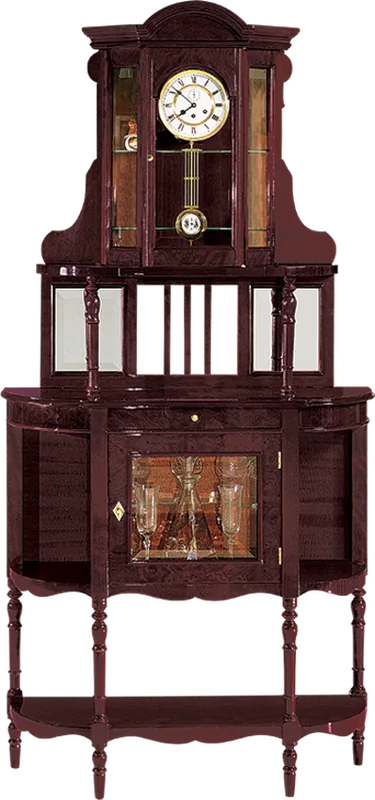
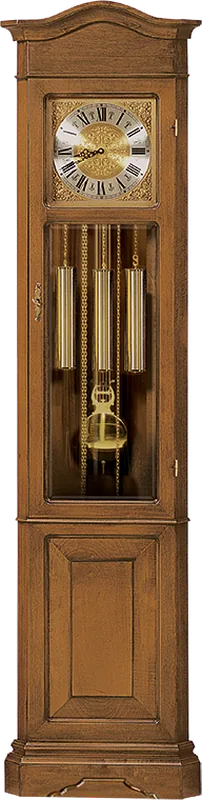
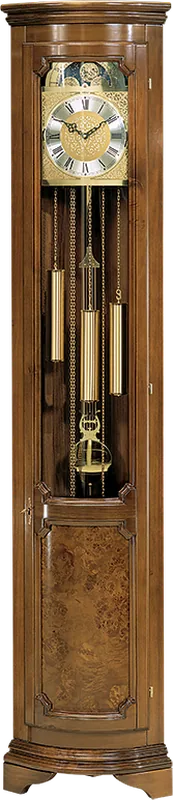
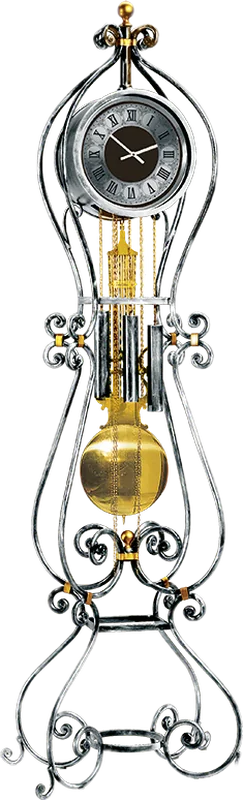
Curio cabinet clock
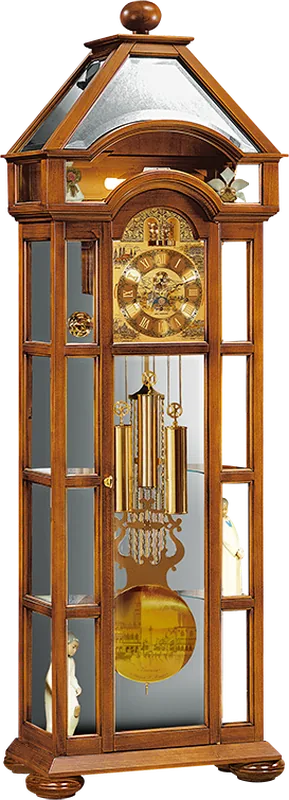
“Victorian Anniversary” was born in 1984 from the English telephone boxes of the Victorian age. It is all solid American tulipwood: the door closes over the uprights, mirrors line the inside and four dancers sit on the dial.
A clock that is yours alone. Wood, finish, colour and melody: we start from this model and finish it together, the way you want it.
- Dimensions
- Height 235 cm · width 76 cm · depth 36 cm · weight 100 kg
- Wood
- Solid American tulipwood, worked on 4 sides and cut at 45° on the door
- Finish
- Blond walnut, semi-gloss, water-based acrylic, applied to the parts before assembly
- Movement
- German Kieninger mechanical movement in mirror-polished brass, made for us; weekly cable winding with the crank in the 3 dial holes; switchable night silencer from 10 pm to 7:15 am; hands can also be turned anticlockwise; held by 2 solid gilt brass supports fixed to the back
- Chime
- Three tunes on 16 notes every hour (Westminster, Schubert's Ave Maria, Beethoven's Ode to Joy), with switchable automatic change; one tone at 15 minutes, two at 30, three at 45
- Dial
- By Jaeckle, with large applied brass Roman numerals on a silvered chapter ring and polished corners; seconds hand; four painted dancers that move every quarter hour; pointed English-style hands
- Pendulum
- Long brass lyre pendulum with a print of St Mark's Square in Venice; decorated weights; by Jaeckle
- Other
- Hand-bevelled glass and mirrors; mirrors along the whole back, one low mirror at the bottom and 3 tilted ones at the top; 4 large glass shelves from side to side; 220 V / 110 V interior light, to switch on now and then or with a timer; hinges that let the door open fully; opens from the top to adjust the bells and arrange objects above the dial; large sphere on top representing the globe; in 2 pieces, the clock and the triangular top; 4 bun feet that unscrew
How it is made
It was designed in 1984 by the Polish-American designer Ed Karpinsky: he took the Victorian English telephone box and opened it up, to show fine woodwork, the German movement and family keepsakes on lit shelves. His first sketches on tracing paper are still in our small museum in Sanguinetto. It was the founder, Antonio Altobel, who turned the sketch into a real clock, above all with the idea of a door cut at 45° that covers the uprights of the case. Over the years we have adapted it to homes all over the world: the wood became tulipwood, in more European colours, and we added the inner mirrors and the glass shelves.
Every piece of solid tulipwood is worked on four sides, then sanded and finished before assembly, so no corner is left with a smear of varnish. The finish is by Giorgio: a semi-gloss blond walnut, water-based acrylic, full-bodied yet simple, cared for on every edge because every centimetre of wood is on view. Giovanni Casella bevels the glass by hand, along with the tilted mirrors at the top and the one at the bottom; the mirrors lining the back are thinner, so as not to add weight. At night the interior light fans out into the room thanks to the mirror near the floor, and the three curved mirrors at the top send the room's light up to the ceiling.
The Kieninger movement with the four dancers and the Jaeckle dial are made specially for us. Every hour it plays one of three tunes on 16 notes, the Westminster chime, Schubert's Ave Maria and Beethoven's Ode to Joy, and it can switch between them by itself; on the quarters it gives one, two or three tones. Every quarter hour the painted dancers spin and move in and out of the dial, as on Marienplatz in Munich. The seconds hand is exact: each slow swing of the pendulum is one second. It is cable-wound once a week, with the crank in the three holes of the dial, and it can stay silent at night.