Tap a photo to enlarge it
SVR.86
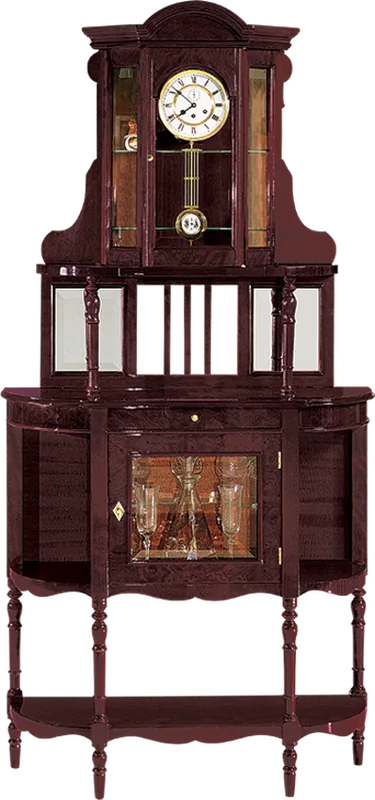
Curio cabinet clock
Part English Liberty style, part dressing table: besides the clock it has mirrors for make-up and hair, shelves and a drawer. The Kieninger movement plays three tunes.
A clock that is yours alone. Wood, finish, colour and melody: we start from this model and finish it together, the way you want it.
- Dimensions
- Height 194 cm · width 96 cm · depth 32 cm · weight 60 kg
- Wood
- Solid American tulipwood with Alpi burl details; 2 crossed reinforcing bars at the back
- Finish
- Glossy mahogany, inside and out, each part finished separately
- Movement
- German Kieninger mechanical movement in brass, spring-driven; weekly key winding in the 3 dial holes; minute hand can also be turned anticlockwise; no automatic night silencer
- Chime
- Westminster, St Michael and Whittington on 8 notes every quarter hour, with the hour strike; side lever to choose the tune or switch the chime off
- Dial
- Round, white, by Jaeckle, with seconds hand
- Pendulum
- By Jaeckle, marked R and A: turning the nut at the bottom makes the clock run slower or faster
- Other
- Drawer; doors with lock; bevelled glass and mirrors; glass shelves; movement tested for 15 days with dial and hands
How it is made
It was made as a dressing table, with mirrors to look at yourself, do your make-up and brush your hair, and at the same time as a curio cabinet with a clock. The case is solid American tulipwood, with many details in Alpi burl. At the back, two crossed bars reinforce the frame and keep it steady.
We build it in pieces: Stefano gives each part a fine glossy mahogany finish, inside and out, and only then do we assemble it. It has the drawer, the doors with a lock, the bevelled glass, the mirrors and the shelves. We season the wood ourselves, naturally: every centimetre of thickness waits at least a year to dry.
The German Kieninger movement plays three tunes, Westminster, St Michael and Whittington, and has a seconds hand. It is spring-driven and wound once a week with the key in the three holes of the dial. We always test the movement, with its dial and hands, for 15 days before fixing it to the case. The minute hand can also be turned backwards.