Tap a photo to enlarge it
SZR.44
Grandfather clock
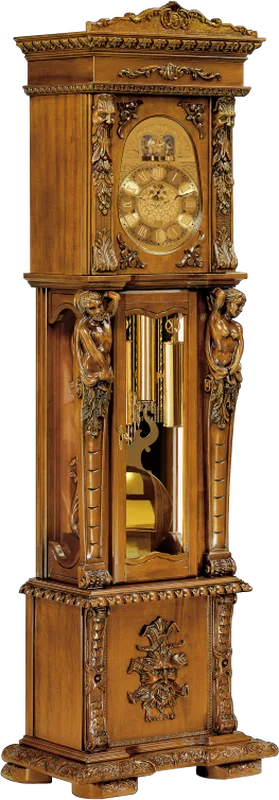
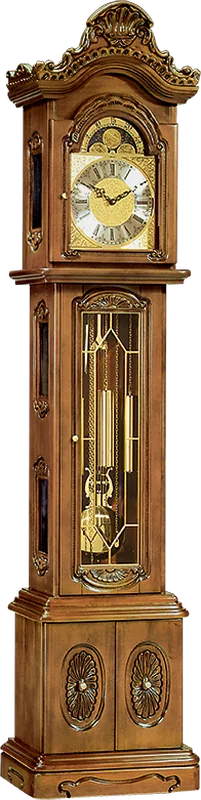
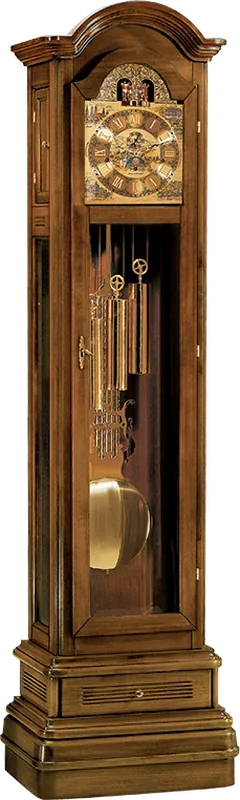
Gentle, bright and traditional. The door and the bevelled glass are thin and let in plenty of light; inside, a Kieninger movement with three chimes and four dancers that come out of the dial.
A clock that is yours alone. Wood, finish, colour and melody: we start from this model and finish it together, the way you want it.
- Dimensions
- Height 201 cm · width 57 cm · depth 34 cm · weight 80 kg
- Wood
- Solid American tulipwood, door included; Tanganyika details on the side doors; birch plywood back
- Finish
- Semi-gloss medium walnut, water-based
- Movement
- German Kieninger mechanical movement in mirror-polished brass; cable-driven, weekly crank winding in the 3 dial holes; switchable night silencer from 10 pm to 7:15 am
- Chime
- Three melodies on 8 notes every quarter hour: Westminster, Whittington, St Michael; hour strike; switchable automatic melody change every hour; long brass-plated bells
- Dial
- Hand-painted by Paul Merkte with Europe's monuments; large applied brass-plated Roman numerals; four dancers in real silver leaf
- Pendulum
- Brass lyre pendulum and decorated weights by Jaeckle
- Other
- Slim door built as three doors; hand-bevelled glass, sides included; 2 side doors; small drawer in the base; 2 slim mirror-polished brass tubes applied to the case; mirror-polished brass winding key
How it is made
It is all solid American tulipwood, the door included, and the back is birch plywood. High on the sides are two small doors with Tanganyika details: they were made for inspecting the movement, which is why they are so large. In the base there is a small drawer for the instructions, the door key and the winding key.
The door looks thin, but it is built as three doors. The outer one closes the front, the inner one pairs with it so no light slips round the edges, and the third is screwed on and holds the glass, bevelled by hand by Giovanni Casella, the large arched pane included. The side glass is bevelled too. Stefano finishes every part on its own, in a semi-gloss, water-based medium walnut, and we assemble it while testing the movement: that keeps the finish clean and smooth, with no small ridges.
The Kieninger movement is large and mirror-polished, even though the case is fairly small. Every quarter hour it plays Westminster, Whittington or St Michael on 8 notes, as you choose, strikes the hours and can change melody by itself every hour. The dial is hand-painted by Paul Merkte, an elderly German impressionist painter, with Europe's great monuments; at the top, four silver-leafed dancers turn and come out every quarter hour, as on Marienplatz in Munich. It is cable-driven, not chain-driven, so the pendulum disc always swings free: it is wound once a week with the crank in the 3 holes on the dial.