Tap a photo to enlarge it
STR.35
Wooden table clock
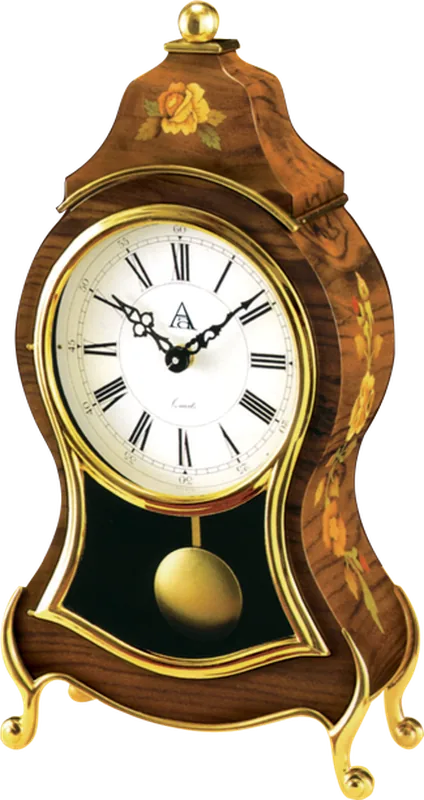
It is named after the Swiss lake: Neuchâtel. A small table clock in walnut inlaid with flowers, with gilt mounts and a glossy finish.
A clock that is yours alone. Wood, finish, colour and melody: we start from this model and finish it together, the way you want it.
- Dimensions
- Height 42 cm · width 23 cm · depth 10 cm
- Materials
- MDF veneered in 1 mm walnut; floral inlay in natural woods (red padauk, maple, green tulipwood and others); zamak mounts gilded in a gold bath
- Finish
- 100% glossy polyester over a primer and an anti-yellowing coat
- Movement
- German Hermle mechanical movement in brass; weekly key winding in the 2 dial holes; turn the hands clockwise only
- Chime
- Bim-bam at the half hour; on the hour counts the strokes with the Dutch double tone; to silence it, wind only the right-hand spring
- Dial
- White aluminium with black Roman numerals, in the northern European tradition
- Pendulum
- Small, with a screw beneath to regulate the time
- Other
- Front door for setting the time and winding; black rear door to reach the movement
How it is made
It follows the Swiss decorative clock par excellence, born in Neuchâtel about 150 years ago. In simpler homes it stood in a corner, on a small corner shelf. The shelf is gone now: today it sits on a chest of drawers, or becomes a gift. We used to make them by the thousand, some with a quartz movement too. The case is high-quality MDF, carefully veneered in 1 mm walnut, with flowers inlaid in natural woods of different colours: red padauk, maple, green tulipwood and others.
We cut the 1 mm slivers of wood with a fretsaw to make up the flowers, fit them into the walnut and press everything onto the base. Even in such a small space, the inlay is well centred on the case. The mounts are zamak, gilded in a gold bath. The finish is glossy, 100% polyester, over a primer and an anti-yellowing coat, so the joints between the woods do not open over time.
It has two doors: the one at the front to set the time and wind the springs, the black one at the back to reach the movement. The brass Hermle movement gives a bim-bam at the half hour and on the hour counts the strokes with the typical Dutch double tone. It is wound with a key once a week; the small pendulum regulates the time, by turning the screw beneath it. The dial is white aluminium with black Roman numerals, as is the tradition in northern Europe.